
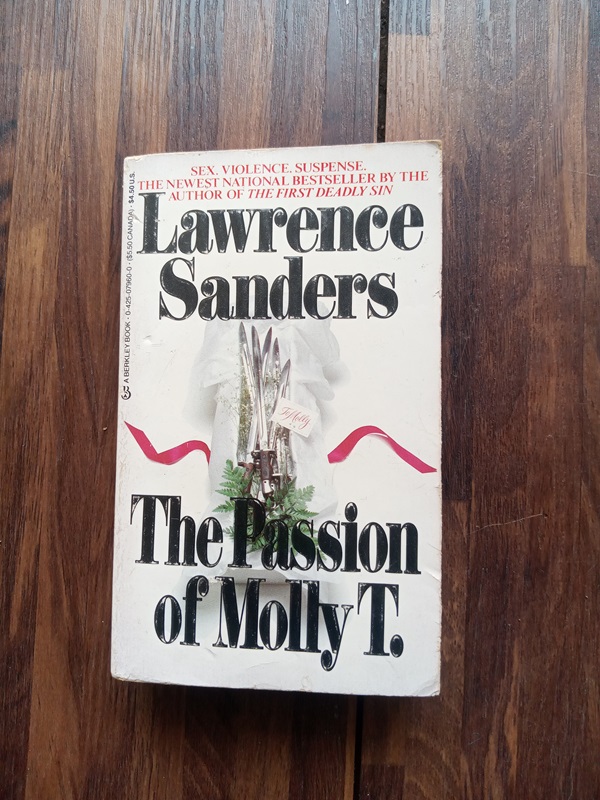
Published in 1984, The Passion of Molly T. is a provocative genre hybrid that blends political thriller, erotic suspense, and speculative feminist fiction.
Written by bestselling crime novelist Lawrence Sanders, the novel projects 1980s gender politics into a heightened near-future landscape to explore a central, unsettling question: what happens when institutional justice consistently fails women, and vigilantism emerges as a perceived alternative?
At its core, the book follows Molly Turner, a charismatic and deeply grieving woman who transforms personal tragedy into organized militant action.
Through its fast-paced, morally ambiguous narrative, the novel examines the boundaries of righteous violence, the commodification of social movements, and the complex interplay between empowerment and extremism.
The Passion of Molly T. Book Setting & Societal Backdrop
The narrative is set in a speculative 1987 United States, grounding its thriller mechanics in recognizable cultural anxieties of the era.
The story oscillates between two primary spheres: the grassroots, working-class communities of West Virginia, where the National Women’s Union (NWU) and its militant offshoot, the Women’s Defense Corps (WDC), take root; and the polished, maneuvering corridors of Washington, D.C., where politicians, media figures, and federal agencies react to and exploit the growing unrest.
The societal climate is characterized by systemic neglect of gender-based violence, rising anti-feminist backlash, sensationalized media coverage, and deep political polarization.
Sanders uses this backdrop not as strict prediction, but as a speculative amplifier: a world where real-world frustrations are pushed to their thriller-logic extremes, forcing characters and readers to confront the costs of uncompromising ideological warfare.
The Passion of Molly T. Book Key Characters & Relationship Dynamics
The novel’s momentum is driven by a tightly interwoven cast whose personal and political trajectories constantly collide:
- Molly Turner serves as the emotional and operational center. Initially a civilian radicalized by the hate-motivated murder of her lover, she evolves into a fiercely driven WDC commander. Her arc traces the transformation of grief into militant purpose, but also the psychological toll of leading a movement built on retribution.
- Rod Harding, Molly’s brother-in-law and a former police officer, provides tactical expertise, insider knowledge of law enforcement, and a grounding in institutional procedure. His alliance with Molly blurs the line between protector and enabler, and his gradual moral compromise becomes a central tension in the narrative.
- Ann Harding, Molly’s sister and Rod’s wife, operates within the NWU’s political apparatus. Initially aligned with Molly’s cause, she increasingly pursues institutional power, leveraging media narratives and political alliances. Her evolution from solidarity to ruthless ambition highlights intra-movement fractures.
- Norma Jane Laughlin, though killed early, functions as the narrative catalyst and symbolic anchor. Her murder represents systemic violence against women and the failure of legal recourse, igniting the chain of events that follows.
- Constance Underwood and congressional figures embody the political machinery that both fears and exploits the WDC. Their maneuvering illustrates how social movements are often co-opted, sanitized, or weaponized for electoral and ideological gain.
The Passion of Molly T. Book Plot Structure (Chronological Breakdown)
Act I: Catalyst & Formation
The novel opens in the aftermath of Norma Jane Laughlin’s brutal murder by local bigots in West Virginia. When legal and institutional avenues prove ineffective or indifferent, Molly’s grief hardens into resolve.
She partners with Rod Harding, whose law enforcement background and tactical acumen make him a natural co-architect of retaliation.
Together, they establish the Women’s Defense Corps (WDC) as the militant wing of the broader National Women’s Union.
Early operations are surgical and ideologically framed: bombings of pornography distributors, targeted executions of convicted rapists, and direct interventions against documented spousal abusers.
The WDC quickly gains underground support, positioning itself as a shadow justice system where traditional courts have failed.
Act II: Escalation & Institutional Response
As the WDC’s campaign intensifies, it captures national attention. Media coverage oscillates between condemnation and sensationalized fascination, while congressional committees launch investigations into domestic terrorism and feminist extremism.
Within the movement, ideological fractures emerge: some members advocate for disciplined, targeted action, while others push for broader, more aggressive strikes.
Rod’s tactical decisions grow increasingly uncompromising, drawing him deeper into moral ambiguity.
Meanwhile, Ann Harding begins maneuvering behind the scenes, aligning with NWU leadership and political operatives to consolidate influence.
The WDC’s operations expand, but so does public anxiety, setting the stage for institutional backlash.
Act III: Fracture & Betrayal
Power struggles within the NWU leadership come to a head. Ann leverages political connections to marginalize Molly’s grassroots authority, repositioning the movement toward media-friendly reformism while quietly enabling more extreme factions for leverage.
Rod, torn between loyalty to Molly, his growing disillusionment with Ann’s political games, and his own tactical compulsions, makes decisions that increasingly isolate him from both sides.
As WDC operations grow less precise and more retaliatory, public support fractures. Personal betrayals intersect with political maneuvering: alliances are broken, informants emerge, and the line between liberation and authoritarianism blurs. The movement begins to consume itself.
Act IV: Climax & Reckoning
The narrative accelerates into a coordinated wave of violence, political assassinations, and high-profile bombings. Law enforcement and federal agencies close in, executing raids and leveraging informants to dismantle WDC cells.
Betrayals are exposed, leadership splinters, and characters are forced into irreversible confrontations. Molly, now isolated from political allies and increasingly burdened by the human cost of the campaign, faces a final reckoning.
Whether through direct confrontation, capture, or strategic retreat, the climax forces a collision between ideology, loyalty, and survival.
The WDC’s original vision is irrevocably transformed by the violence it unleashed and the political forces that anticipated its escalation.
Act V: Resolution & Aftermath
In the wake of the crackdown, the novel examines the immediate and long-term fallout. Key characters face arrest, exile, or political scapegoating.
Media narratives are carefully curated to paint the WDC as a fringe terrorist organization, while politicians leverage the panic to advance legislation restricting protest and civil liberties.
The fate of Molly and core figures remains deliberately ambiguous or tragically conclusive, emphasizing the human cost of ideological warfare.
The movement’s legacy is fractured: some view it as a necessary warning against systemic complacency, others as a cautionary tale about the corrupting nature of vengeance.
The novel closes on unresolved questions about justice, accountability, and the price of radical action.
The Passion of Molly T. Book Central Themes & Motifs
- Vigilantism vs. Institutional Justice: The book interrogates whether extralegal violence can ever be morally justified when legal systems consistently fail marginalized groups. It refuses easy answers, instead illustrating how retaliation often replicates the brutality it seeks to dismantle.
- The Male Gaze & Erotic Thriller Tropes: Marketed partly as an erotic suspense novel, the narrative navigates a tension between feminist militancy and the sexualized framing of female characters. Critics have noted this duality as both a commercial strategy and a point of thematic contradiction.
- Cycles of Violence: Retaliation begets escalation. The WDC’s early precision dissolves into broader, more indiscriminate strikes, demonstrating how movements built on vengeance struggle to maintain ethical boundaries.
- Political Exploitation & Co-optation: The novel sharply depicts how grassroots movements are often neutralized, sanitized, or weaponized by political elites. Fear becomes a legislative tool; solidarity becomes a bargaining chip.
- Sisterhood & Power Dynamics: Loyalty, ambition, and ideology fracture female solidarity. The story explores how power operates even within marginalized movements, revealing that liberation struggles are not immune to the hierarchies they oppose.
The Passion of Molly T. Book Narrative Style & Structural Choices
Sanders employs a thriller-driven pacing, intercutting operational sequences with political maneuvering, media commentary, and intimate character moments.
The narrative is typically rendered in a close third-person perspective, shifting focus among Molly, Rod, Ann, and political figures to maintain suspense and ideological tension.
The prose is lean and procedural, reflecting Sanders’ background in crime fiction, but layered with speculative realism that grounds the heightened plot in recognizable social dynamics.
Genre blending is deliberate: the book borrows from police procedurals, political thrillers, and erotic suspense, using each to amplify different facets of its central conflict.
This structural choice keeps the narrative propulsive while allowing thematic depth to emerge through action rather than exposition.
Critical & Cultural Context
Upon release, The Passion of Molly T. divided critics and readers. Publications like Kirkus Reviews dismissed it as a melodramatic exercise with implausible politics and stereotypical characterizations, while The New York Times acknowledged its sharp observation of political mechanics but questioned its narrative plausibility.
Many early critiques focused on the disconnect between its feminist subject matter and its male authorship, particularly regarding the sexualized framing of female characters and the thriller’s reliance on sensational violence.
However, in subsequent decades, especially following the #MeToo movement and renewed discourse around gender-based violence, the novel has been reevaluated by some readers as a provocative, if flawed, exploration of systemic failure and radical response.
It occupies a niche space in 1980s speculative thrillers, often discussed alongside works that used genre fiction to interrogate social anxiety, institutional distrust, and the limits of reform.
Its legacy lies less in literary polish than in its unflinching willingness to stage uncomfortable questions about justice, power, and the cost of uncompromising conviction.
You May Also Like to Look at:
Conclusion
The Passion of Molly T. is a morally complex, structurally driven thriller that uses speculative fiction to amplify real-world tensions surrounding gender, justice, and political power.
While its execution bears the hallmarks of 1980s genre conventions—including pacing-driven prose, heightened violence, and occasional reliance on sensational tropes—its core narrative remains provocatively unresolved.
The novel does not offer a tidy moral verdict; instead, it stages a collision between systemic failure and radical response, leaving readers to grapple with the consequences of each.
For scholars of genre fiction, it serves as a case study in how thriller mechanics can be weaponized to explore social anxiety. For readers, it remains a polarizing but undeniably compelling examination of what happens when the demand for justice outpaces the institutions designed to deliver it.
Have you read this book? Kindly share your thoughts via the comment form below…
