
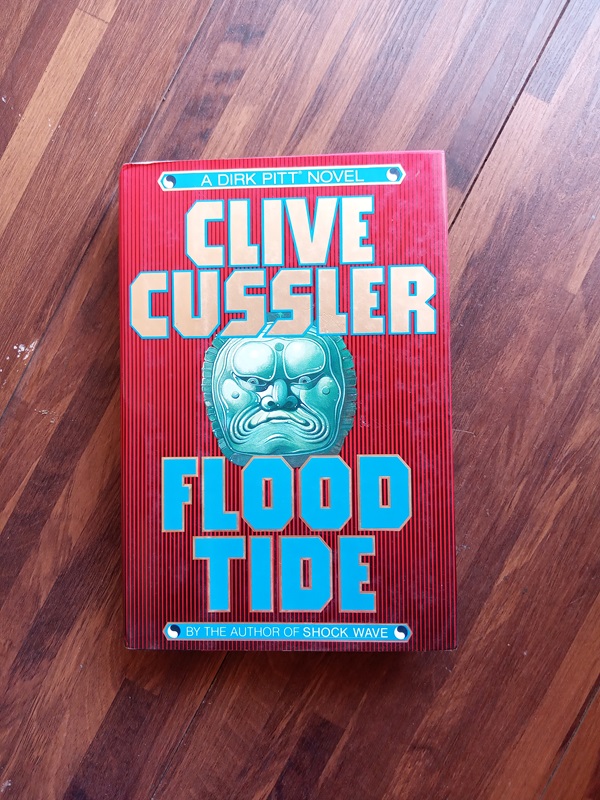
Flood Tide (1997) is the fourteenth installment in Clive Cussler’s long-running Dirk Pitt Adventures series. Published by Simon & Schuster’s Pocket Books imprint, the novel firmly occupies the maritime adventure thriller genre, blending fast-paced pulp action with historical mystery and contemporary geopolitical conspiracy.
The narrative operates on a dual-timeline structure: a meticulously crafted 1948 prologue establishes a sunken treasure and unresolved historical tragedy, which seamlessly propels the reader into a late-1990s present-day investigation. At its core, the novel follows NUMA (National Underwater and Marine Agency) director Dirk Pitt as he uncovers a sophisticated human-smuggling syndicate that masks a far more diabolical plot: an engineered catastrophic flood designed to erase evidence, eliminate opposition, and cement a criminal empire’s dominance.
The book exemplifies Cussler’s signature formula: nautical authenticity, globe-trotting set pieces, clear moral stakes, and an optimistic, technologically adept hero operating outside traditional bureaucratic constraints.
Flood Tide Historical Prologue (1948)
The novel opens in the immediate aftermath of World War II, as China descends into civil war. Aboard the luxury cruise liner Princess Dou Wan, a clandestine operation unfolds under the authority of Chiang Kai-shek’s retreating government.
The ship carries a hidden cargo of priceless Chinese antiquities: bronze relics, jade artifacts, and imperial documents smuggled out to fund the Nationalist cause or secure political asylum. Before the vessel can reach safe waters, it is caught in a violent Pacific typhoon. Navigational systems fail, the crew is overwhelmed, and the ship vanishes beneath the waves with all hands and its irreplaceable cargo.
This prologue serves multiple narrative functions: it establishes the historical MacGuffin that will later intersect with the modern plot, introduces themes of greed, displacement, and institutional corruption, and plants the underwater mystery that NUMA will eventually be tasked with solving.
Flood Tide Present-Day Inciting Incident & Character Introduction
The narrative shifts to the late 1990s, introducing Dirk Pitt and Al Giordino in their established roles as NUMA’s field operatives and problem-solvers. Pitt is characterized by his intuitive leadership, maritime expertise, and dry wit, while Giordino serves as his loyal, technically brilliant counterpart with a penchant for tactical improvisation.
The inciting incident occurs when Pitt intercepts a violent confrontation on the Pacific coast and rescues a battered undercover immigration agent from a heavily armed enforcement team. Initially appearing as a routine interdiction, the rescue quickly reveals deeper layers: the agents work for a sophisticated smuggling network with unusual operational security, advanced maritime logistics, and clear political insulation.
As Pitt examines the agent’s fragmented intelligence, NUMA transitions from a standalone rescue operation to a formal investigation, setting the stage for a sprawling confrontation between law enforcement, corporate power, and criminal enterprise.
Flood Tide The Antagonist & The Conspiracy
The primary antagonist, Qin Shang, is introduced as a ruthless shipping magnate whose legitimate maritime empire serves as a front for human trafficking and illicit artifact trade. Shang’s operation is remarkably insulated: he uses massive campaign contributions and shell companies to buy influence with high-ranking U.S. politicians, effectively blinding federal agencies to his activities.
His smuggling network centers on a concealed, fully operational seaport hidden deep within the Louisiana bayous, complete with dredged channels, fortified warehouses, and covert transit routes. However, Shang’s ambitions extend far beyond profit.
The novel reveals the titular “Flood Tide” plot: a meticulously engineered disaster involving the sabotage of regional levees and flood-control infrastructure. By triggering a catastrophic inundation, Shang aims to drown evidence of his operations, eliminate key witnesses, and force a federal emergency response that will grant him lucrative reconstruction contracts while permanently burying his criminal footprint.
Flood Tide Investigation & Rising Action
NUMA deploys its full technological and investigative arsenal to unravel Shang’s empire. Through sonar mapping, underwater drone reconnaissance, and archival research, Pitt and his team recover fragments of the Princess Dou Wan’s cargo, uncovering shipping manifests and encrypted financial records that directly link the 1948 shipwreck to Shang’s modern smuggling routes.
The investigation is punctuated by escalating action set pieces: high-speed maritime chases along the Pacific coast, close-quarters infiltrations of coastal warehouses, and hazardous underwater salvage operations hampered by strong currents and submerged debris.
Interpersonal dynamics add depth to the procedural core: Pitt develops a protective partnership with the rescued agent, Giordino provides tactical support and darkly humorous relief, and NUMA faces mounting bureaucratic pressure from compromised officials demanding the investigation be shut down.
As Pitt pieces together the “Flood Tide” blueprint, the stakes become intensely personal and geographically urgent, with a narrow window to prevent mass civilian casualties.
Climax
All narrative threads converge in a high-stakes, multi-stage climax centered on the Mississippi River and the hidden bayou stronghold. Pitt, Giordino, and a small NUMA tactical team execute a daring riverine insertion, navigating treacherous waters while evading Shang’s private security fleet.
The sequence blends naval-style maneuvering, environmental hazards, and rapid-fire tactical decision-making. Upon infiltrating the concealed port, the team discovers the flood-trigger mechanism already armed and counting down. A tense stealth operation gives way to direct confrontation as Shang’s forces mobilize.
Pitt engages Shang in a physical and ideological clash that underscores the novel’s moral framework: greed and exploitation versus duty and preservation. Through quick thinking, improvised engineering, and precise timing, Pitt disables the flood mechanism, contains the breach, and neutralizes Shang’s operational command. The immediate aftermath sees the bayou port seized, key operatives captured, and the catastrophic inundation narrowly averted.
Resolution & Aftermath
The resolution ties together the novel’s historical and contemporary arcs. Shang is defeated, his political accomplices exposed through leaked financial records, and the human-smuggling network dismantled by coordinated federal action.
NUMA successfully recovers the Princess Dou Wan’s remaining antiquities, which are repatriated for historical preservation and scholarly study, providing closure to the 1948 tragedy.
Character arcs reach satisfying endpoints: Pitt and Giordino’s partnership is reaffirmed through shared trials, the rescued agent’s mission is validated, and NUMA’s independence is temporarily secured despite bureaucratic friction.
The novel closes with subtle nods to the agency’s ongoing mandate, leaving room for future adventures while delivering a self-contained, thematically complete narrative.
Themes, Motifs & Stylistic Elements
Flood Tide operates on several intertwined thematic levels. Its maritime authenticity is evident in precise nautical terminology, realistic ship mechanics, and detailed underwater exploration sequences, drawing heavily on Cussler’s real-life NUMA expeditions.
The novel tackles immigration and exploitation, framing human trafficking not as abstract crime but as systemic dehumanization, while contrasting it with historical artifact smuggling to show how greed transcends eras.
Power and corruption are central motifs: Shang’s campaign finance manipulation illustrates how wealth can distort democratic institutions, while NUMA’s extra-bureaucratic status highlights the tension between accountability and effectiveness.
Cussler’s stylistic hallmarks are prominent: brisk pacing, dialogue-driven exposition, meticulously engineered set pieces, and an unapologetically optimistic heroism that emphasizes competence, loyalty, and moral clarity over cynicism.
Critical Reception & Series Context
Commercially, Flood Tide performed strongly, cementing Cussler’s status as a bestselling adventure novelist. It has seen numerous reprints, paperback releases, and audiobook editions, maintaining steady readership across decades.
Critical and reader reception has been largely favorable: reviewers praised the novel’s kinetic pacing, imaginative maritime sequences, and successful integration of historical mystery into modern thriller frameworks.
Some critics noted that the political framing occasionally leans toward broad strokes, and that character development outside the core trio remains functional rather than deeply layered. Within the Dirk Pitt canon, Flood Tide marks a transitional phase where NUMA’s role expands from underwater salvage to broader geopolitical intervention, and Pitt’s character evolves from solo adventurer to institutional leader.
The novel remains a fan favorite for its classic adventure structure and has influenced later entries in Cussler’s bibliography.
You May Also Like:
In Conclusion
Flood Tide successfully balances historical intrigue, contemporary conspiracy, and high-octane maritime action, delivering a tightly plotted thriller that honors Clive Cussler’s signature style while exploring timely ethical questions.
Its dual-timeline structure creates narrative symmetry, linking past exploitation to modern corruption, while its climax exemplifies the series’ trademark blend of tactical ingenuity and environmental peril.
Ideal for readers who enjoy classic adventure fiction, nautical realism, and serialized heroic narratives, the novel stands as a strong mid-series entry that leverages Cussler’s authentic maritime knowledge and unwavering commitment to pacing and set-piece craftsmanship.
Despite minor critiques regarding political nuance, Flood Tide remains a compelling, self-contained adventure that reinforces why the Dirk Pitt series has endured as a cornerstone of modern thriller fiction.
