Home » Books Point Blog » Diary of a Wimpy Kid Book Summary

Diary of a Wimpy Kid Book Summary

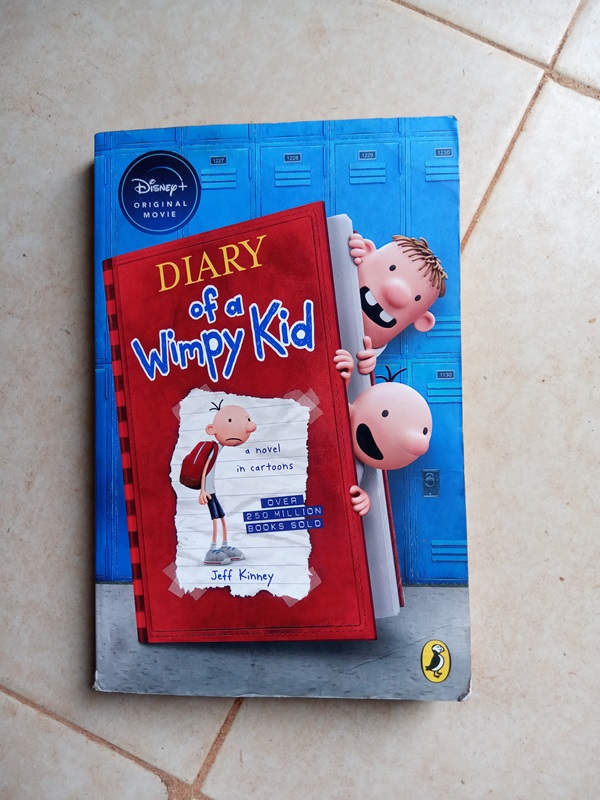
Published in April 2007, Diary of a Wimpy Kid is the debut entry in Jeff Kinney’s bestselling middle-grade series. Presented as a handwritten “journal” (though Greg repeatedly insists it’s not a diary), the book merges short prose entries with simple, expressive line-drawn cartoons.

This hybrid format mimics a real kids notebook, creating an immediate, accessible reading experience. The diary conceit allows Kinney to pace the story episodically, using visual punchlines, marginal doodles, and timeline gaps to deliver humor and subtext. Importantly, Greg’s voice is deliberately unreliable: his written rationalizations often clash with what the cartoons reveal, creating a steady stream of dramatic irony that rewards attentive readers.

Diary of a Wimpy Kid Premise & Setting the Stage

The story follows twelve-year-old Greg Heffley as he navigates his first year of middle school. Greg enters with a clear, self-serving mission: survive socially, climb the unspoken popularity ladder, and document his life so he can achieve fame later.

He views middle school as a system to be gamed rather than a community to join. The book quickly establishes its core cast and social ecosystem: Rowley Jefferson, Greg’s earnest and slightly naive best friend; Rodrick, Greg’s older brother and drummer for the band Löded Diper; Manny, the spoiled youngest sibling who manipulates adult sympathy; and Greg’s well-meaning but often out-of-touch parents.

Through Greg’s eyes, middle school is a landscape of arbitrary rules, shifting alliances, and survival tactics, setting up a narrative driven by social ambition, friendship, and comedic missteps.

Diary of a Wimpy Kid Plot Arc Breakdown

September–October: The Middle School Shock

Greg’s early entries capture the disorientation of middle school: locker combinations that defy logic, gym class humiliations, and the harsh reality that elementary school rules no longer apply.

He immediately begins plotting ways to gain status, from trying to manipulate the yearbook committee to positioning himself near popular kids.

The playground’s most infamous legend, the Cheese Touch, is introduced as a potent metaphor for social contagion and the fear of ostracism.

Greg’s early schemes are clumsy but revealing of his worldview: he wants success without effort, popularity without vulnerability.

November–January: Schemes, Seasons & Social Shifts

As the school year progresses, Greg’s attempts to control his environment repeatedly backfire. Halloween brings a disastrous group costume incident that highlights his willingness to sacrifice Rowley’s comfort for social gain.

The Valentine’s Day dance becomes a focal point for Greg’s crush on older student Holly Hills, leading to awkward attempts at maturity that only underscore his immaturity.

At home, Rodrick’s teenage apathy, Manny’s calculated innocence, and his parents misguided disciplinary strategies (like forced family bonding or arbitrary reward systems) create a comedic backdrop that mirrors the school’s social chaos.

Greg’s belief that he can engineer his way to popularity grows increasingly fragile.

February–April: Fractures & Fallout

The central tension shifts to Greg and Rowley’s friendship. Rowley accidentally gains attention and popularity, often because his genuine, unfiltered behavior is misread as “cool” or rebellious.

Greg, threatened by Rowley’s unexpected social rise, begins distancing himself, attempting to rebrand their friendship and even sabotage Rowley’s reputation.

Key incidents include a Safety Patrol power trip, a comic book rivalry, and Greg’s growing willingness to blame Rowley for his own failures. The friendship fractures under the weight of Greg’s jealousy and social anxiety, marking the emotional low point of the book.

May–June: Climax & Resolution

The narrative culminates in a playground crisis involving the Cheese Touch. When Rowley is labeled the new carrier, Greg panics and publicly abandons him to protect his own social standing.

The backlash is swift: Greg is branded a coward and a traitor. Facing isolation, he is forced to confront the consequences of his actions.

Rowley, unbothered and resilient, moves on with his usual good nature, and the two eventually reconcile—not through a grand moral awakening, but through quiet, authentic acknowledgment.

Greg ends the school year exactly where he began: middle-class in social status, journal in hand, slightly wiser but largely unchanged. The book closes on a note of comedic realism rather than tidy triumph.

Diary of a Wimpy Kid Character Dynamics & Development

  • Greg Heffley: The self-appointed narrator and anti-hero. Greg is status-obsessed, deeply insecure, and constantly rationalizing his behavior. He rarely learns overt moral lessons, which is precisely what makes him compelling: readers recognize their own petty ambitions, social fears, and self-deceptions in his exaggerated form.
  • Rowley Jefferson: The moral and emotional anchor. Rowley’s innocence, loyalty, and lack of guile contrast sharply with Greg’s calculations. He succeeds socially not by trying, but by being authentically himself.
  • Rodrick & Manny: Sibling foils. Rodrick represents teenage detachment and mild cruelty, while Manny weaponizes childhood innocence. Both highlights how family dynamics shape Greg’s view of power and manipulation.
  • Adults & Authority Figures: Consistently well-intentioned but comically out of sync with kid logic. Their interventions often backfire, reinforcing the book’s child-centric worldview and emphasizing that middle school operates on its own social physics.

Recurring Motifs & Humor Mechanics

Kinney’s humor operates on multiple levels. The Cheese Touch functions as a brilliant stand-in for middle school’s arbitrary status systems and fear-based conformity.

The interplay between text and illustration creates consistent comedic irony: Greg’s prose claims maturity or control, while the cartoons reveal panic, failure, or pettiness.

Running gags (the “diary vs. journal” debate, Löded Diper’s terrible music, video game obsessions, family road trips, and school policy absurdities) build a cohesive, lived-in world.

Crucially, the comedy never punches down; it laughs at Greg’s flaws while treating childhood social anxiety with genuine empathy.

Core Themes & Underlying Messages

  • Friendship vs. Social Climbing: The book explores how the pursuit of status can corrode loyalty, and how authentic connection often requires vulnerability Greg isn’t ready to offer.
  • Self-Deception & Accountability: Greg’s journal is a mirror he refuses to look into honestly. The narrative gently suggests that growth begins when rationalization meets consequence.
  • Middle School as Microcosm: The school’s social hierarchy mirrors adult society’s emphasis on image, conformity, and unspoken rules. Kids navigate these pressures with limited tools, making their struggles universally relatable.
  • The Appeal of the Imperfect Protagonist: Greg resonates because he’s allowed to be flawed without being villainized. Readers see their own awkward phases, failed schemes, and social missteps reflected safely in his exaggerated failures.

Conclusion & Cultural Footprint

Diary of a Wimpy Kid (Book 1) established a publishing phenomenon by bridging traditional prose and visual storytelling, creating a highly accessible format that became a gateway for reluctant readers and a staple of middle-grade literature.

Its success lies in balancing laugh-out-loud comedy with subtle social observation, never moralizing but consistently revealing the gap between how kids see themselves and how they actually behave.

While Greg doesn’t undergo a traditional character arc, the book’s episodic structure and emotional honesty create a satisfying, standalone narrative that naturally invites readers into the series.

Decades after its release, the book remains a cultural touchstone precisely because it treats middle school not as a problem to be solved, but as an experience to be survived, documented, and eventually laughed about.

We did a complete list of the Diary of a Wimpy Kid books that also contains movie adaptations and much more.

Kindly head out to our children and teen section to check if we have an available copy. And yes, we value your thoughts – kindly share them via the comment form below…

Leave a Comment

Your email address will not be published. Required fields are marked *

Need Help?
Scroll to Top