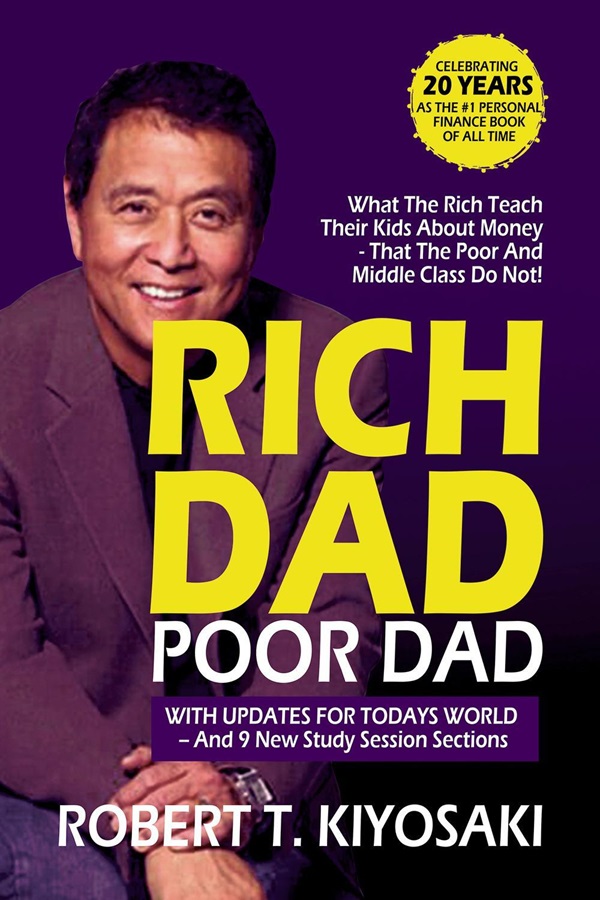
Since its publication in 1997, Robert T. Kiyosaki’s Rich Dad Poor Dad has sold tens of millions of copies worldwide, cementing its place as the #1 personal finance book of all time. But what makes this book so enduringly popular?
Unlike most finance books that give you complex charts and stock-picking advice, Rich Dad Poor Dad is about one thing: shifting your mindset about money.
If you are short on time, here is the TL; DR (Too Long; Didn’t Read) of the book’s core message:
- The rich don’t work for money; they make money work for them.
- You must know the difference between an asset and a liability, and buy assets.
- Your primary house is not an asset; it’s a liability that takes money out of your pocket.
- Financial literacy is just as important as formal education.
- Work to learn new skills, not just to earn a paycheck.
Ready to dive into the full book? Read the book summary below – Grab a gently used, affordable copy of Rich Dad Poor Dad today at and start your journey to financial freedom!
Rich Dad Poor Dad – The Core Premise: Two Dads, Two Mindsets
The book is framed around the contrasting financial philosophies of the two father figures in Robert Kiyosaki’s life.
“Poor Dad” (His Biological Father) Robert’s biological father was highly educated, holding a Ph.D. He worked hard his entire life for the government, believing in the traditional recipe for success: Go to school, get good grades, and find a secure, well-paying job with benefits. Despite his high income, he struggled with debt his whole life and left behind bills to pay when he died. His mindset was: “I can’t afford it,” which stopped him from thinking.
“Rich Dad” (His Best Friend’s Father) His friend’s father never finished the eighth grade, but he became one of the wealthiest men in Hawaii. He was an entrepreneur and an investor. He believed in financial literacy, taking calculated risks, and building businesses. His mindset was: “How can I afford it?” which forced his brain to think and find solutions. He left behind millions, as well as a legacy of financial education.
The core conflict of the book—and Kiyosaki’s life—was choosing which “dad” to listen to. Ultimately, he chose to learn from the Rich Dad.
The 6 Core Lessons of Rich Dad Poor Dad
Lesson 1: The Rich Don’t Work for Money
The poor and the middle-class work for money. They trade their time for a paycheck, driven by two emotions: fear (of being without money) and greed/desire (to buy things). This creates the “Rat Race”—working harder and harder for a paycheck that never seems to be enough.
The rich, however, do not work for money. They acquire or create assets that generate income. Because their money works for them, they can make money even while they sleep. Kiyosaki urges readers to stop chasing a paycheck and start focusing on acquiring income-generating assets.
Lesson 2: Why Teach Financial Literacy? (Assets vs. Liabilities)
This is arguably the most important chapter in the book. Kiyosaki argues that schools teach us to be good employees, but not how to handle money. To build wealth, you must understand the difference between an asset and a liability.
Kiyosaki simplifies accounting with his own golden rule:
- An Asset puts money in your pocket. (e.g., rental real estate, dividend-paying stocks, a business that runs without you, intellectual property/royalties).
- A Liability takes money out of your pocket. (e.g., car loans, credit card debt, expensive subscriptions).
The Myth of the House: Kiyosaki controversially states that your primary residence is not an asset; it is a liability. While it may go up in value, it takes money out of your pocket every month through mortgage payments, property taxes, insurance, and maintenance. The rich buy real assets; the poor and middle class buy liabilities that they think are assets.
Lesson 3: Mind Your Own Business
Kiyosaki draws a sharp distinction between your profession and your business.
- Your profession is what you do 9-to-5 to pay the bills (e.g., you are a banker, a teacher, an engineer).
- Your business is what you own (your asset column).
Kiyosaki’s advice? Keep your day job and mind your boss’s business to pay the bills, but start minding your own business by aggressively building your asset column on the side. Don’t spend your extra income on liabilities (like a new car); spend it on assets (like stocks or real estate).
Lesson 4: The History of Taxes and the Power of Corporations
Kiyosaki explains that the rich use legal corporate structures to protect their money and minimize their tax burden, while the middle class gets taxed the heaviest.
He outlines the cash flow patterns of the three classes:
- The Poor & Middle-Class Pattern: Earn → Pay Taxes → Spend (What’s left).
- The Rich Pattern (Using a corporation): Earn → Spend (Business expenses) → Pay Taxes (On what’s left).
By understanding the law and the tax code, the rich legally keep more of what they earn. (Note: Always consult a local tax professional in Kenya or your respective country to apply these legal structures correctly).
Lesson 5: The Rich Invent Money
Self-doubt and the fear of losing money keep most people poor. The rich, however, have a high “Financial IQ” and are not afraid to take calculated risks.
“Inventing money” means having the financial intelligence to see opportunities that others miss. Instead of waiting for a “lucky break” or a good job, the rich create their own opportunities by understanding how to raise capital, how to organize smart people, and how to spot undervalued assets.
Lesson 6: Work to Learn—Don’t Work for Money
When Kiyosaki was young, his Rich Dad advised him to take jobs for the skills he would learn, not the money he would earn.
He recommends that young people seek out jobs in sales, marketing, communications, and leadership. Kiyosaki believes that being a “generalist” (knowing a little bit about a lot of things, especially sales and marketing) is far more important to building wealth than being a hyper-specialist. As he says, “The primary managed skill for success is the ability to communicate, sell, and market.”
Overcoming the 5 Main Obstacles to Wealth as Taught in the Rich Dad Poor Dad Book
Even with financial literacy, people fail to build wealth because of five main obstacles:
- Fear: Specifically, the fear of losing money. The rich know that losing money is part of the learning process.
- Cynicism: Listening to the “Chicken Littles” who always say the sky is falling. Doubt and cynicism cause people to miss out on great opportunities.
- Laziness: Busy people are often the laziest. They stay busy at work or with chores to avoid facing their financial problems.
- Bad Habits: The most crucial habit is to pay yourself first. Before paying your bills, allocate money to your asset column. The pressure of unpaid bills will force you to find ways to make more money.
- Arrogance: Arrogance is ego plus ignorance. If you think you know it all, you will lose money. Acknowledge what you don’t know and seek expert advice.
10 Steps to Develop Your Financial Genius
At the end of the book, Kiyosaki provides 10 actionable steps to develop your financial intelligence:
- Find a reason greater than reality: The power of spirit. You need a strong “why” (e.g., freedom, providing for family) to push through hard times.
- Make daily choices: The power of choice. Every shilling/dollar you spend is a choice to be rich, poor, or middle class.
- Choose friends carefully: The power of association. Don’t take financial advice from broke friends.
- Master a formula and then learn a new one: The power of learning quickly.
- Pay yourself first: The power of self-discipline.
- Pay your brokers well: The power of good advice. Good brokers save you time and make you money.
- Be an “Indian Giver”: The power of getting something for nothing. (A reference to getting a return on your investment while also getting your initial capital back).
- Use assets to buy luxuries: The power of focus. Don’t buy a luxury car on credit; buy it using the cash flow generated by your assets.
- The need for heroes: The power of myth. Study the investors who came before you to make the process seem easy.
- Teach and you shall receive: The power of giving. If you want money, give money. If you want sales, teach sales.
Rich Dad Poor Dad Critical Review: What the Book Gets Right (and What It Misses)
No book is perfect. While Rich Dad Poor Dad is a masterpiece of mindset, it has its critics. Here is a balanced look:
What it gets right:
- Mindset Shift: It brilliantly breaks the psychological chains of the “employee mindset” and empowers readers to think like owners.
- Simplicity: The definition of assets and liabilities is incredibly simple and easy to remember.
- Focus on Financial Education: It correctly highlights the massive gap in traditional schooling regarding personal finance.
What it misses (The Critiques):
- US-Centric Advice: Much of his real estate and tax advice is highly specific to the United States in the 1990s and doesn’t always translate perfectly to other countries (like Kenya) without local legal/tax adjustments.
- Dismissal of Diversification: Kiyosaki heavily criticizes the traditional advice of “diversify your investments” (like buying mutual funds or index funds). Modern financial experts heavily debate this, noting that for the average person, low-cost index funds are a much safer path to wealth than picking individual real estate deals or stocks.
- Risk Underestimation: The book sometimes makes entrepreneurship and real estate investing sound easier than they are, downplaying the very real risks of leverage and debt.
Conclusion & Final Thoughts
Rich Dad Poor Dad is not a step-by-step technical manual on how to pick stocks or file your taxes. It is a book about changing your paradigm. It asks you to stop viewing money as something you work for, and start viewing it as a tool that you can direct to work for you.
If you change the way you look at money, you can change your life.
Ready to change your financial mindset? The best way to absorb these lessons is to read the book yourself and take the first step toward financial freedom today! Check book availability by contacting us now via WhatsApp…
Expand Your Financial Library
If you loved the mindset shifts in Rich Dad Poor Dad, here are more books to help you on your journey. All are available at Bookspoint!
More by Robert T. Kiyosaki:
- The Cashflow Quadrant: The perfect sequel. It breaks down the four types of people in the business world (Employee, Self-Employed, Business Owner, Investor) and how to move from the left side to the right side.
- Rich Dad’s Guide to Investing: A deeper dive into what the rich actually invest in.
Similar Must-Read Finance Books:
- The Psychology of Money by Morgan Housel: A brilliant modern look at how our emotions and ego dictate our financial success.
- The Intelligent Investor by Benjamin Graham: The bible of value investing, highly recommended by Warren Buffett.
- Think and Grow Rich by Napoleon Hill: The classic foundational text on the mindset of wealth creation.
