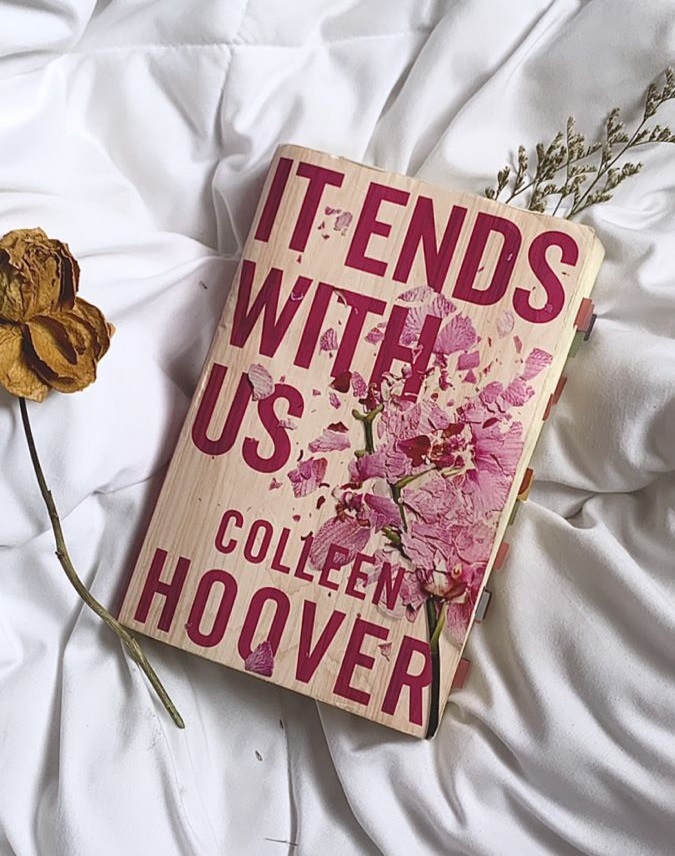
If you’ve spent any time on Book Tok, Instagram Reels, or even just around a Nairobi book club, chances are you’ve heard of It Ends with Us. Colleen Hoover’s 2016 novel became one of the best-selling books in the world years after its original release, thanks to a wave of social media buzz — and then again in 2024, when the Blake Lively and Justin Baldoni film adaptation brought it back into headlines, this time for reasons that had little to do with the plot itself.
But behind the viral moment is a story that has genuinely resonated with millions of readers: a story about love, generational trauma, and the difficult, often unglamorous process of breaking a cycle of abuse.
Here’s everything you need to know before you pick up a copy.
About the Author
Colleen Hoover is an American author who has become one of the defining voices in contemporary romance and romantic suspense fiction. She’s written dozens of novels, including Verity, Ugly Love, November 9, and the Hopeless series, but It Ends with Us remains her most personal and most discussed work — largely because it draws directly from her own mother’s experience surviving domestic abuse.
It Ends With Us Plot Summary (Full Spoilers)
Note: this section reveals the entire plot, including the ending. If you’d rather discover the story yourself, skip to the “Themes” section below.
The novel follows Lily Bloom, a young woman who moves to Boston after her father’s funeral and opens her own flower shop, despite having no business background and very little savings. At her father’s funeral, Lily delivers a eulogy notable for what it leaves out: she refuses to say anything kind about him, hinting early on that their relationship was deeply troubled.
Shortly after arriving in Boston, Lily meets Ryle Kincaid, a driven, wealthy neurosurgeon, on a rooftop one night. Their chemistry is immediate and intense. Ryle is charming and successful, but he’s also blunt about the fact that he doesn’t do relationships — he prefers no-strings-attached encounters, a stance he attributes to the demands of his surgical career and a family tragedy involving his older brother’s accidental death, for which he still carries guilt.
As Lily builds her flower shop with the help of her new employee and friend Allysa — who, in a twist, turns out to be Ryle’s sister — she keeps running into him. Despite his declared aversion to commitment, Ryle pursues Lily, and the two fall into a relationship neither of them originally intended to have.
Interwoven with this present-day narrative are diary entries Lily wrote as a teenager, addressed to talk-show host Ellen DeGeneres. These flashbacks reveal Lily’s first real relationship: with a homeless teenage boy named Atlas Corrigan, whom she secretly took in and cared for while he was estranged from his own family. The diary entries also gradually reveal that Lily’s father was physically abusive toward her mother throughout Lily’s childhood — a reality Lily rarely discusses in the present day.
As Lily and Ryle’s relationship deepens, cracks begin to show. Ryle reacts to jealousy and stress with sudden, frightening bursts of anger. The first incident happens in his kitchen — what starts as a playful moment turns violent when Ryle, in a fit of jealous rage after finding a message from Atlas on Lily’s phone, pushes her into a hot oven door, badly burning her arm. He immediately apologizes, blames the reaction on exhaustion and a stressful day at the hospital, and Lily — like so many people in her position — makes excuses for him.
The cycle repeats. A later, more severe incident occurs when Atlas and Lily unexpectedly run into each other at his restaurant; Ryle, consumed by jealousy, assaults Lily so violently that she ends up temporarily unconscious and requires hospital treatment. Once again, he apologizes, and — critically — Lily discovers she is pregnant shortly after.
Believing she can build a stable family despite everything, Lily marries Ryle. But the abuse doesn’t stop. A final, brutal incident occurs when Ryle, once again triggered by jealousy over Atlas, attacks Lily while she’s pregnant, in a scene that mirrors the abuse Lily witnessed her own mother endure as a child. This time, something shifts in Lily. She recognizes, with brutal clarity, that she is living out the very pattern she swore she’d never repeat.
After giving birth to their daughter, Emerson, Lily makes the decision to leave Ryle — not out of hatred, but out of a hard-won understanding that loving someone is not a good enough reason to stay if it means passing the same cycle on to her daughter. In one of the novel’s most quoted scenes, Lily tells Ryle that if their daughter were ever in the same position, she would want her to leave — and that she owes herself the same courage.
The novel closes with Lily finalizing her divorce from Ryle, co-parenting Emerson, and reconnecting with Atlas — not as an instant fairytale reunion, but as the tentative beginning of a healthier relationship, built on the lessons Lily has fought hard to learn.
It Ends With Us – Themes Explored
- Breaking cycles of domestic abuse — the novel’s central and most powerful theme. Hoover doesn’t portray abuse as a single monstrous act but as a slow, confusing cycle of love, violence, apology, and hope that traps even intelligent, strong-willed people.
- The complexity of loving an abuser — Ryle isn’t written as a cartoonish villain; he’s charming, successful, and often genuinely remorseful, which is exactly what makes the book uncomfortable and realistic. It reflects how real abusive relationships often work.
- Generational trauma — Lily’s journey is shaped by having grown up watching her mother endure abuse, and the novel asks whether patterns like this can truly be broken.
- Self-worth and courage — leaving isn’t framed as easy or triumphant, but as an act of quiet, difficult courage.
- First love versus safety — the Atlas storyline isn’t just a love triangle; it represents the contrast between passion and the kind of steady safety Lily comes to value by the end.
Why It’s So Divisive
It Ends with Us is loved by many readers for its raw honesty and emotional depth, and Hoover has spoken publicly about writing it as a tribute to her mother’s strength. At the same time, it’s been criticized by some readers and domestic violence advocates for potentially romanticizing Ryle for much of the book, and for a marketing approach (including branded merchandise) that some felt was tone-deaf for a story centered on abuse.
Hoover has addressed this criticism directly, saying the book was never meant to romanticize abuse but to portray how difficult it can be to recognize and leave it. This tension is part of why the book generates so much conversation — it doesn’t offer easy answers, and readers often come away with strong, differing opinions.
Who Should Read It Ends With Us (Content Note)
This book deals directly and repeatedly with domestic violence, including scenes of physical abuse, and touches on themes of parental conflict witnessed by a child. It’s best suited to mature teen readers and adults. If you or someone shopping with you has a personal history with domestic violence, it’s worth knowing this going in — some readers find it cathartic, others find it triggering.
Frequently Asked Questions
Is It Ends with Us based on a true story? Not directly, but Colleen Hoover has said the character of Lily’s mother was inspired by her own mother’s real experience of domestic abuse.
Is there a movie? Yes. A film adaptation was released in 2024, starring Blake Lively as Lily and Justin Baldoni as Ryle.
Is there a sequel? Yes — It Starts with Us (2022), which continues the story primarily from Atlas’s point of view.
Is it appropriate for teenagers? Given the graphic depictions of domestic violence, it’s generally recommended for older teens and adults rather than younger readers.
Do I need to read the books in order? Yes — It Ends with Us should be read before It Starts with Us for the story to make sense.
Get Your Copy at Books Point
Whether you’re picking it up because of the Book Tok buzz, the film, or a friend’s recommendation, It Ends with Us is one of those rare books that sparks real conversation. Visit Books Point in Ruaka to check availability, or get in touch to reserve a copy — we also carry the sequel, It Starts with Us, for readers ready to continue Lily and Atlas’s story.
Before you go, kindly head to the complete list of colleen Hoover Books and see what to read next…
