
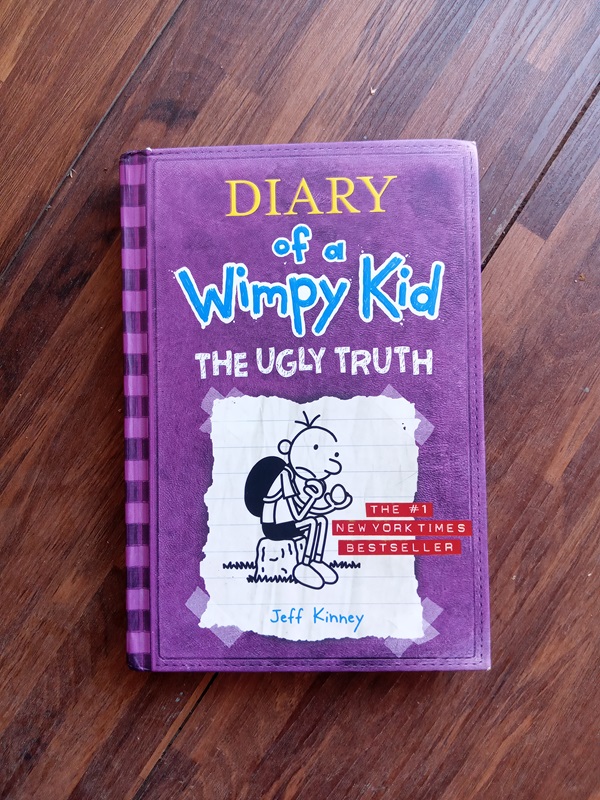
This is a Deep-Dive Summary of Diary of a Wimpy Kid, Book 5 (The Ugly Truth). Growing up rarely arrives with a warning label. For Greg Heffley, it crashes through the door in the form of awkward conversations, shifting friendships, and a household suddenly thrown off balance.
Published in 2010 as the fifth installment in Jeff Kinney’s Diary of a Wimpy Kid series, The Ugly Truth marks a quiet but decisive turning point. Where earlier books relied on episodic misadventures to keep Greg comfortably stuck in middle school, this entry finally lets time move forward—and with it, the messy realities of adolescence.
At its core, the book is about what happens when avoidance stops working. As Greg’s carefully constructed defenses crumble, he’s forced to confront puberty, the fragile mechanics of friendship, and the uncomfortable realization that “acting older” doesn’t actually make you mature. Rather than dodging the chaos of middle school, Greg is thrust directly into it—and the fallout reveals far more than he’s prepared to admit.
The Ugly Truth Plot Arc: Cause, Effect, and Escalation
The book’s momentum begins with a double destabilization: Greg’s fallout with Rowley removes his social safety net just as his mother’s return to college strips the Heffley household of its emotional anchor. Suddenly, Greg is navigating a world without his usual crutches.
He’s thrust into boy-girl parties he doesn’t understand, saddled with orthodontic headgear he desperately tries to hide, and forced to tolerate a housekeeper who treats his bedroom like a personal resort. Each mishap compounds the last, pushing Greg further out of his comfort zone.
The narrative pressure peaks during a school lock-in, where Greg and Rowley are stranded together after hours. Stripped of adult supervision and social posturing, the two boys must actually communicate to survive the night. Shortly after, Greg receives “the talk” about puberty from his ninety-five-year-old great-grandmother—a scene that weaponizes awkward humor to underscore a blunt reality: growing up isn’t a milestone you prepare for, but a biological and emotional shift you simply survive.
By the time the school year closes, Greg hasn’t magically transformed into a model adolescent. Instead, he reaches a quiet, hard-won realization: maturity isn’t a switch you flip. It’s a series of choices, apologies, and small course corrections. These plot beats aren’t random comedic set pieces; they’re carefully stacked dominoes that force Greg to face what he’s spent four books trying to outrun. And to understand why those dominoes fall the way they do, you have to look at who’s pushing them.
Character Dynamics: Mirrors and Foils
Greg remains the series’ brilliant unreliable narrator, but his self-deception is on full display in this installment. He constantly frames himself as the victim of circumstance, yet the diary’s illustrations routinely undercut his version of events—capturing the smug expressions, poor decisions, and quiet selfishness he refuses to acknowledge.
Rowley, by contrast, operates with a straightforward emotional transparency that highlights Greg’s stagnation. Where Greg calculates social leverage, Rowley simply feels and adapts. Their reconciliation isn’t earned through grand gestures, but through mutual vulnerability: Rowley’s willingness to apologize and Greg’s reluctant acceptance that friendship requires maintenance, not entitlement.
The Heffley household amplifies this internal friction. Susan’s absence leaves a parenting vacuum, Frank’s rigid expectations clash with adolescent reality, and Manny’s unchecked privilege creates an environment where Greg’s anxieties are both fueled and ignored. The family doesn’t just provide backdrop comedy; it functions as a microcosm of Greg’s psychological landscape. When the home system falters, Greg’s coping mechanisms fracture—and that’s exactly where the story’s deeper tensions emerge.
Core Themes: What “The Ugly Truth” Actually Explores
These character collisions give shape to the book’s central question: What does it actually mean to grow up? Kinney answers by dismantling three popular middle-school myths. First, puberty is treated not as an exciting rite of passage, but as a profound loss of control. Greg’s orthodontic disaster, his fumbling at mixed-gender social events, and the clinical yet bewildering “talk” with his great-grandmother all reinforce that physical and emotional changes don’t follow a syllabus.
Second, the book reframes friendship as active labor rather than passive entitlement. Greg spends much of the narrative waiting for Rowley to orbit back to him on Greg’s terms. The lock-in sequence shatters that illusion, proving that relationships require accountability and the willingness to be wrong.
Finally, Kinney quietly dismantles the fantasy of “maturity.” Greg equates looking older or attending cooler parties with being grown up, only to learn that real maturity shows up in small, unglamorous moments: admitting fault, listening instead of performing, and accepting that discomfort is part of the process. Rather than sanitizing or mocking tween anxiety, the narrative validates it.
Growing up isn’t framed as something to conquer; it’s something to navigate, one awkward step at a time. And Kinney doesn’t just tell readers this—he engineers the reading experience to make them feel it.
Narrative Craft: Why the Diary Format Serves the Story
What makes this thematic depth land so effectively isn’t just what Kinney writes; it’s how he structures the page itself. The diary format functions as a masterclass in visual irony. Greg’s text consistently rationalizes his behavior, while the accompanying doodles expose the gap between his self-image and reality. A panel might show him shrugging off a mistake, while the caption reveals a spiral of internal panic. This dual-layer storytelling allows reluctant readers to engage with emotional complexity without feeling lectured to.
Kinney also leverages pacing and white space intentionally. Short entries, fragmented layouts, and abrupt scene shifts mirror the erratic attention spans and emotional whiplash of early adolescence. Most significantly, this book marks Kinney’s deliberate decision to stop keeping Greg frozen in time.
He’s spoken in interviews about weighing whether to preserve the series as an ageless comic strip or let the characters age realistically. The Ugly Truth is where that gamble pays off. By allowing puberty and social maturation to unfold on the page, Kinney transforms the diary from a running gag into a genuine psychological document. The craft doesn’t just serve the joke; it serves the truth the title promises—and that’s precisely why the book resonated so powerfully upon release.
Reception & Cultural Resonance
The Ugly Truth moved nearly 550,000 copies in its first week, securing its place on bestseller lists and in classroom libraries worldwide. Critics and educators praised its ability to balance laugh-out-loud humor with genuine emotional stakes, while parents found it to be an unexpectedly useful bridge into conversations about puberty, peer pressure, and accountability.
For reluctant readers, the visual-text interplay lowers the barrier to entry without diluting the content. For confident readers, it offers a layered portrait of friendship and self-awareness that rewards repeated reading.
At a time when middle-grade fiction often leaned into high fantasy or heavy realism, Kinney offered something quieter and arguably more radical: a portrait of ordinary discomfort that refused to talk down to its audience. The book’s enduring popularity isn’t just a testament to brand loyalty; it’s proof that children’s literature thrives when it honors the actual experience of growing up—messy, uncertain, and deeply human.
Conclusion: The Lasting Takeaway
The Ugly Truth is more than a middle school comedy; it’s the moment Greg Heffley’s survival strategies finally catch up with him. By letting his characters age, Kinney trades the comfort of stasis for the friction of growth, proving that adolescence isn’t about gaining control—it’s about learning to move forward when you feel completely unprepared. For young readers, the book offers a rare gift: permission to be awkward. For adults, it’s a reminder of how much we romanticize or sanitize the actual passage into teenage years. Nearly fifteen years after its publication, it remains the series’ most emotionally honest installment, and arguably the one that taught a generation that growing up isn’t a problem to be solved, but a process to be lived.
Our children’s and teen bookshelf section has more books for you… Head to this section and see all the books we have in stock.
You May Also Like:
Have you read The Ugly Truth with a young reader, or revisited it as an adult? Which of Greg’s “ugly truths” felt the most familiar to your own middle school years? Share your take in the comments below.
